
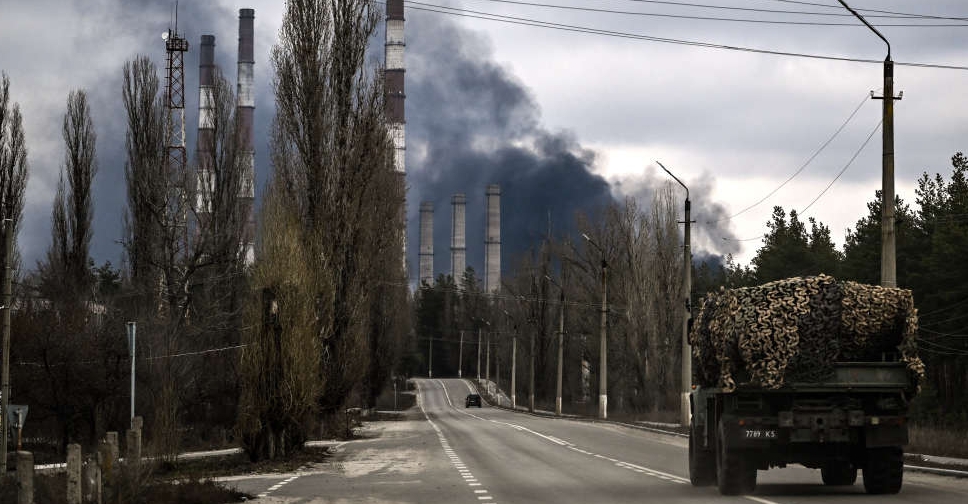
Ukraine will introduce a nationwide state of emergency in which special restrictions will apply in order to keep the country calm and protect its economy amid fears of a Russian invasion.
The state of emergency will last for 30 days and can be extended for another 30 days, senior Ukrainian security official Oleksiy Danilov told a briefing.
Parliament must now vote to enact the decision.
Introducing a state of emergency gives powers to the authorities, who can choose which ones to implement. These could include restrictions on transport, extra protection for critical infrastructure and a ban on strikes.
Regional authorities can make decisions on whether to introduce curfews and other measures, Danilov said.
"These are preventive measures to keep calm in the country, so that our economy and our country can work," Danilov said.
"Depending on the threats that may arise in certain territories, there will be either a more strengthened or more weakened state of emergency. We are talking about border areas where we have a border with the Russian Federation, with Belarus," he said.
Ukraine has introduced a series of measures including the conscription of reservists as it braces for a possible military offensive from Russia, which sent troops into eastern Ukraine this week to prop up two breakaway regions.
Danilov reiterated that Ukraine was not introducing general mobilisation yet.
Some lawmakers have urged the government to impose martial law - a move that could trigger a response from Russia. Danilov said no such decision had been taken yet.
"If necessary, this provision will be adopted immediately," he said.
Martial law would impose harder restrictions, which could include bans on meetings, movements and political parties.
The state border guards service said new measures had been introduced regarding the stay of foreigners near the border zone, the use of radios, flights of drones and the filming and photographing of certain people and buildings.
The state of emergency applies to all of Ukraine except the Donetsk and Luhansk regions, where it has been in place since 2014.
Russian-backed fighters have controlled parts of Donetsk and Luhansk since 2014. Russia recognised them as independent states and approved use of its troops abroad this week.
Danilov also said that President Volodymyr Zelenskiy had not discussed the development of nuclear weapons, something Russian President Vladimir Putin has said posed a strategic threat for Russia.


 Mediator Pakistan says US, Iran expected to sign initial deal within 24 hours
 India Air Force plane crash kills all five onboard
 Ukrainian strike kills one, wounds 3 in southern Russia
 Trump says US military strike killed leader of Venezuela's Tren de Aragua gang
 Qatar rejects media report on energy production decisions
 Trump says Iran war deal close as Strait of Hormuz tensions linger
 Victims' families mark Air India crash anniversary with prayers and tributes
 Ebola outbreak spreads to crowded displacement camp in Congo