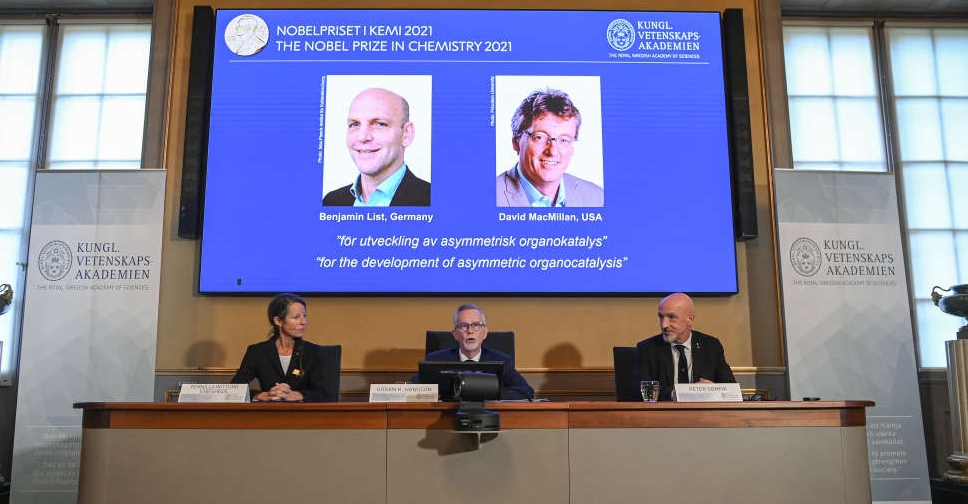
German Benjamin List and Scottish-born David MacMillan won the 2021 Nobel Prize in Chemistry for their development of asymmetric organocatalysis, a "new and ingenious tool for molecule building".
"Organic catalysts can be used to drive multitudes of chemical reactions," the Royal Swedish Academy of Sciences said in a statement. "Using these reactions, researchers can now more efficiently construct anything from new pharmaceuticals to molecules that can capture light in solar cells."
It said these catalysts were both environmentally friendly and cheap to produce.
The more than century-old prize is awarded by the Royal Swedish Academy of Sciences and is worth 10 million Swedish crowns ($1.14 million).
The Nobel prizes, for achievements in science, literature and peace, were created and funded in the will of Swedish dynamite inventor and businessman Alfred Nobel. They have been awarded since 1901, with the economics prize first handed out in 1969.
The chemistry award is the third of this year's crop of Nobel prizes and follows the prizes for medicine or physiology, and physics, announced earlier this week.
Previous winners of the Chemistry prize include Marie Curie and Fredrick Sanger, who won twice.
Seven women have won, including last year's laureates Emmanuelle Charpentier and Jennifer Doudna who were awarded the prize for creating genetic 'scissors' that can edit DNA.


 Saudi civil defence sends all-clear after alerts issued for capital Riyadh
 US and Denmark reach deal on Greenland
 Trump extends push for $100,000 H-1B visas by another year
 Death toll in Pakistan police compound attack climbs to 31
 Trump bans three media outlets from White House
 Three students killed in Philippine school shooting, including gunman, officials say
 At least 16 killed in attack on police facility in northwest Pakistan
 Trump nominee Lindberg to head World Food Programme