

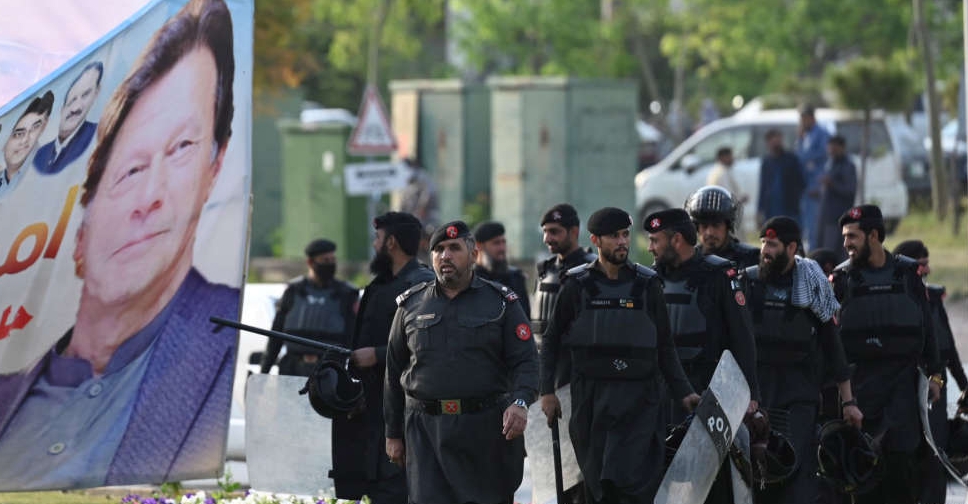
Pakistan's top court will meet on Monday to decide on the fate of Prime Minister Imran Khan, after his party blocked a no-confidence vote and he dissolved parliament in a surprise move to prevent his ouster.
Former cricket star Khan lost his majority in parliament last week as his opponents built their support, and he was facing a no-confidence motion tabled by the opposition on Sunday.
But the deputy speaker of parliament, a member of Khan's party, blocked the motion that Khan had widely been expected to lose, ruling it was part of a foreign conspiracy and unconstitutional.
The move throws the nuclear-armed nation, which the military has ruled for almost half its history, into a full-blown constitutional crisis, with opposition leader Shehbaz Sharif calling the blocking of the vote "nothing short of high treason".
"The nation is stunned," the English-language newspaper Dawn said in an editorial.
"Even as political pundits and the media confidently predicted Mr Imran Khan’s defeat in the vote of no-confidence, he seemed unperturbed.
"No one could have guessed that his last ploy would involve having the democratic order burnt down."
The largely ceremonial head of state, President Arif Alvi, said on Twitter on Monday that Khan would stay on as prime minister in a caretaker role.
Khan wants a general election within 90 days, though that decision officially rests with the president and the election commission.
The Supreme Court is due to meet at 1:00 pm (0800 GMT) to begin its deliberation.
It could order parliament be reconstituted, call for a new election, or bar Khan from standing again if he is found to have acted unconstitutionally.
The court could also decide that it cannot intervene in parliamentary affairs.
Khan says he did not act unconstitutionally, calling the move to oust him a plot orchestrated by the United States - a claim Washington denies.
Political analysts say the military regarded Khan's conservative, nationalist agenda favourably when he won election in 2018 but later cooled towards him over various wrangles.
The military denies involvement in civilian politics but the generals are unlikely to stand by if they thought political chaos was damaging the country or if their core interests were threatened.


 Fire in rebel-held east Congo kills 24 schoolchildren
 Trump touts $5,000 payout if Republicans win as Vance waits in wings
 Search expands after Philippine ferry fire kills five and leaves dozens missing
 Trump says Iran war to end after US midterm elections
 At least 20 killed in cargo vessel fire at China shipyard, state media reports
 US military says it struck vessel in Caribbean, killing 3
 At least 14 killed in explosion at weapons depot in Syria
 US hits five Iranian oil tankers after attack on Navy ships