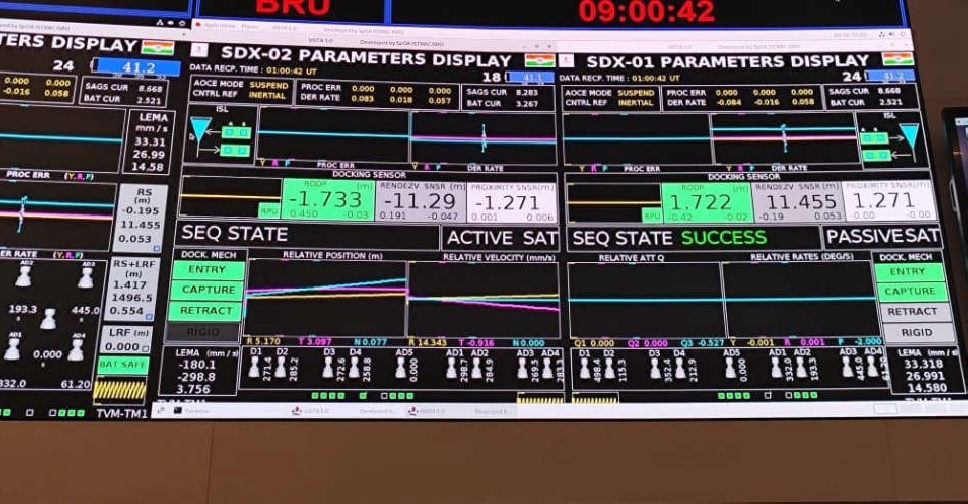
India on Thursday became the fourth nation in the world to achieve space docking, a technological milestone that underscores its ambitions to expand its share in the rapidly growing $400 billion global space market.
At around 9:00 a.m. IST (0330 GMT), the Indian Space Research Organisation (ISRO) carried out the highly anticipated Space Docking Experiment (SpaDeX), a spokesperson for the agency said.
Two ISRO satellites, Target and Chaser — each roughly the size of a large refrigerator — successfully latched onto each other and unlatched after a series of complex orbital manoeuvres.
The indigenous technology, crucial for satellite servicing, space station operations, and interplanetary missions, positions India to play a significant role in the commercial and exploratory frontiers of space.
"India has ambitious missions planned and to achieve those this is an important technology we have to have. Various missions like building a space station need assembly in space, which is not possible without space docking," Indian astrophysicist Jayant Murthy said.
The mission was postponed twice earlier - first because the docking process needed further validation through ground simulations, and later because of an issue arising from excess drift between the satellites.
SpaDeX, launched on December 30 from India's main spaceport, used an Indian-made rocket to deploy the satellites into orbit. Among various payloads and experiments were eight cowpea seeds ISRO had sent to space onboard the rocket to study plant growth in microgravity conditions, which germinated within four days of the launch of the mission.
The mission will also demonstrate the transfer of electric power between docked spacecraft, a capability vital for applications like in-space robotics, composite spacecraft control and payload operations post-undocking.
Such technologies are essential for missions requiring multiple rocket launches to achieve shared objectives.
Space exploration and commercialisation is a key part of Indian Prime Minister Narendra Modi's efforts to position the country as a global superpower.
The successful SpaDeX mission "is a significant stepping stone for India’s ambitious space missions in the years to come," Modi said on X on Thursday.
ISRO is focused on deep-space exploration and enabling private companies to commercialise the sector, with projects that include solar studies, orbital astronaut missions and planetary defence, in collaboration with NASA.
The stakes are significant. While the global commercial space market is expected to reach $1 trillion by 2030, India's current share is just 2 per cent, or $8 billion. The government aims to grow this to $44 billion by 2040.

 US, Iran inch closer to deal, timing remains unclear
 Israel says military attacks Hezbollah targets in Beirut's southern suburbs
 Swiss voters reject population cap in referendum, avoiding EU clash
 Zelenskyy says Ukraine hit oil facility, chemical plant in Russia
 Sirens sound in Jordan due to technical malfunction, state TV reports
 India Air Force plane crash kills all five onboard
 Ukrainian strike kills one, wounds 3 in southern Russia
 Trump says US military strike killed leader of Venezuela's Tren de Aragua gang