

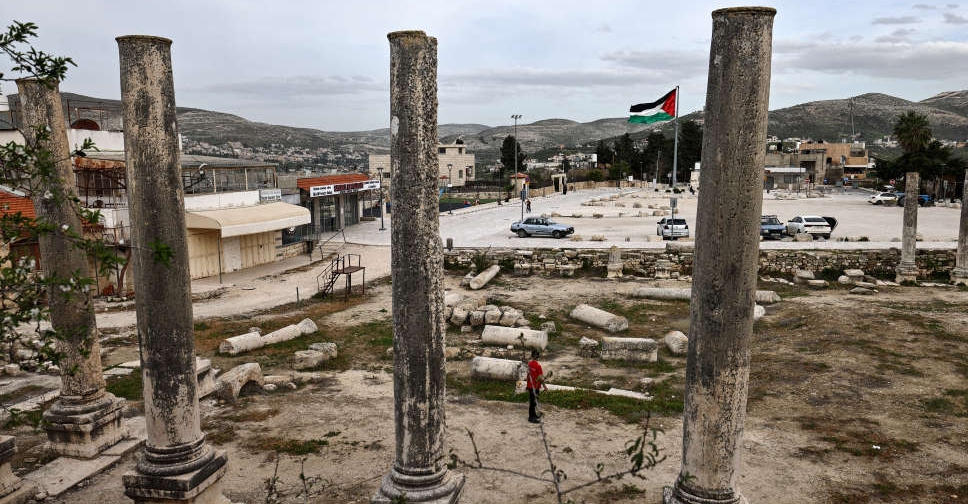
Palestinian officials welcomed UNESCO's designation of Sebastia in the occupied West Bank as a World Heritage site, hoping it will prevent Israel extending its control at the ancient village, while Israel condemned it as a political decision.
Sebastia, in the northern West Bank, has archaeological remnants from successive periods dating back at least to the 9th-century BC capital of the Israelite kingdom, through the Hellenistic, Roman, Byzantine, Islamic periods, Crusader and Ottoman eras, according to UNESCO, the United Nations cultural organisation.
Olive trees surround the site, dotting a landscape of Roman columns, ancient walls and stone steps and an amphitheatre. It is traditionally seen as the burial place of John the Baptist.
But Palestinian residents of the adjacent village, many of whom rely on tourism for a living, are facing land confiscations after Israel announced a plan to seize about 445 acres at the site, which it said was meant to develop the area.
On Friday, UNESCO added Sebastia to its World Heritage List and to the List of World Heritage in Danger, a related mechanism used to flag listed heritage sites that are facing serious threats, to try and safeguard them.
"We hope that this decision will enable us to preserve Sebastia," said Nizar Kayed, the village deputy mayor. He said that Israel's land seizure decision, announced in late 2025, was part of an Israeli push to expand settlements in the area.
The Palestinian tourism and foreign ministries said on Friday that they hoped the UNESCO recognition would help mobilise international support against Israeli measures there.
Israel's Foreign Minister Gideon Saar said the UNESCO decision was part of a Palestinian drive to obscure Jewish ties to the land. "No vote in an international organisation can change history," he said in a statement.
Palestinian officials are also concerned about a new Israeli bill, that has yet to be written into law, that would extend Israeli civil control over ancient sites in the West Bank.
That in effect would strip away oversight of the ancient sites from the Western-backed Palestinian Authority, which under the 1990s Oslo peace accords has exercised limited self-rule in parts of the West Bank, territory Israel captured in a 1967 war.

 Fire in rebel-held east Congo kills 24 schoolchildren
 Trump touts $5,000 payout if Republicans win as Vance waits in wings
 Search expands after Philippine ferry fire kills five and leaves dozens missing
 Trump says Iran war to end after US midterm elections
 At least 20 killed in cargo vessel fire at China shipyard, state media reports
 US military says it struck vessel in Caribbean, killing 3
 At least 14 killed in explosion at weapons depot in Syria
 US hits five Iranian oil tankers after attack on Navy ships