

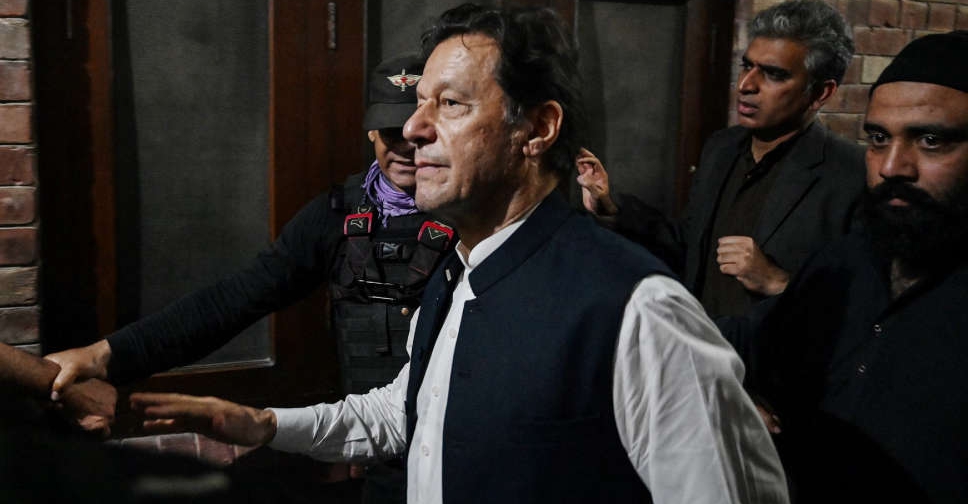
Pakistan curbed access on Wednesday to its capital, Islamabad, ahead of a march planned by supporters of jailed former Prime Minister Imran Khan, blocking major highways with shipping containers and deploying tens of thousands of security forces.
The show of force is the starkest sign in years of how divisions between Khan's Pakistan Tehreek-e-Insaf (PTI) party and the military-backed government have polarised the South Asian nation of 240 million.
Ahead of Sunday's planned march, authorities detained three of Khan's sisters and hundreds of party activists in recent days, citing a need to maintain public order.
The PTI's last large-scale protest two years ago ended in deadly clashes with security forces.
SECURITY STEPPED UP, TWO HIGHWAYS SHUT
Nearly 35,000 additional police and paramilitary personnel have been stationed in and around the capital, an Interior Ministry official said on Wednesday, speaking on condition of anonymity because he was not authorised to speak publicly.
More have been deployed in other parts of the country where protesters may gather.
Two major highways linking Islamabad to the northwestern province of Khyber Pakhtunkhwa, governed by Khan's party, have also been closed until further notice, the National Highway Authority said.
Shipping containers were seen being placed in recent days to barricade Islamabad's government district, home to parliament, the prime minister's residence, and foreign embassies.
Khan, 73, a former cricket star ousted by parliament in a 2022 no-confidence vote, has claimed to be a political prisoner.
Before his 2023 arrest, he had fallen out with the military, which is seen as the ultimate arbiter of politics in the nuclear-armed nation. The military denies his claim to be a political prisoner.
On Monday, Interior Minister Mohsin Naqvi warned that police were told to respond forcefully if the march turned violent, adding, "It is not like that they come and they fire shots and you do nothing."
KHAN'S PARTY SAYS MARCH WILL PROCEED
PTI party chairman Gohar Khan said the march would proceed despite the blockade.
It comes more than a month after the government defied a court order and refused Khan treatment in a private hospital, despite mounting concerns over his health.
The protest also coincides with public discontent over inflation and rising fuel prices that has spread beyond Khan's core supporters.
"There should be freedom of expression and freedom of speech," said Muhammad Asad ul Asaf, a student. "The government has created a full atmosphere of fear."Muhammad Zeeshan, an unemployed mechanical engineer, said the curbs in Islamabad were piling pressure on an already-burdened public. "Businesses face problems and people face difficulties in commuting," he said, while "inflation is increasing day by day."
Khan's 2023 arrest sparked nationwide riots that threatened the standing of the Pakistani military in unprecedented ways when protesters stormed military installations.
Cases against him ranged from concerns over state gifts to instigating violent attacks on military and state installations, and an accusation of an unlawful marriage.
All convictions but one have since been suspended or overturned, with appeals pending. He denies wrongdoing.

 Hope for progress after US, Iran hold first shuttle talks in months
 Four killed in Gaza in strikes, Israel says it killed a Hamas finance chief
 Philippine Senate lowers threshold for conviction in VP Duterte's impeachment trial
 Search continues after death toll from capsized Indonesia ship rises to 20
 Trump urges complete isolation of Iran, expects deal after election
 Canada to pledge $70 million in international aid for Palestine
 Mexico classrooms go phone-free under new school rules
 South African house party shooting kills 11, could be gang violence