

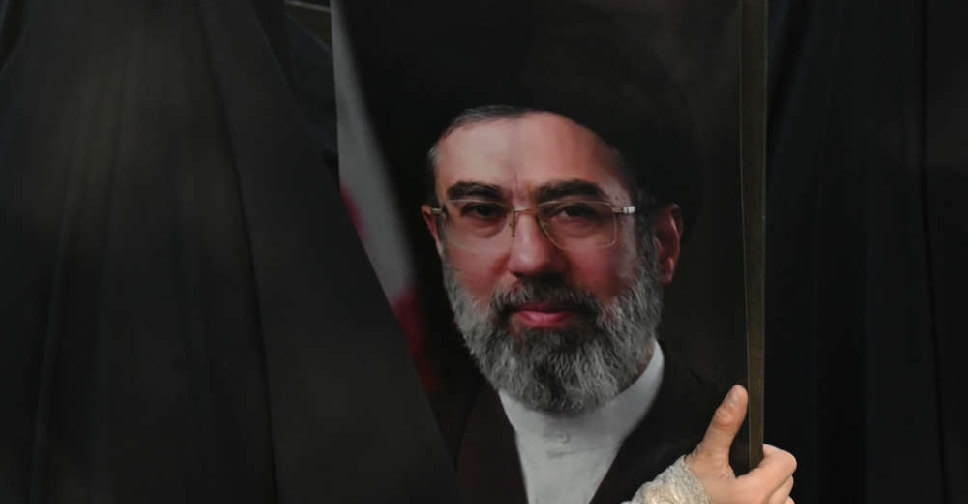
Iran's new Supreme Leader Mojtaba Khamenei is wounded and likely disfigured, US Defence Secretary Pete Hegseth said on Friday, questioning Khamenei's ability to govern after nearly two weeks of US and Israeli attacks.
No images have been released of Khamenei since an Israeli strike at the start of the war that killed much of his family, including his father and wife.
His first comments came in a statement read out by a television presenter on Thursday.
In the statement, he vowed to keep the Strait of Hormuz shut and called on neighbouring countries to close US bases on their territory or risk Iran targeting them.
"We know the new so-called not so supreme leader is wounded and likely disfigured. He put out a statement yesterday. A weak one, actually, but there was no voice and there was no video. It was a written statement," Hegseth told a briefing.
"Iran has plenty of cameras and plenty of voice recorders. Why a written statement? I think you know why. His father - dead. He's scared, he's injured, he's on the run and he lacks legitimacy."
An Iranian official told Reuters on Wednesday that the newly appointed supreme leader was lightly injured but was continuing to operate, after state television described him as war-wounded.
Hegseth was joined by General Dan Caine, the chairman of the Joint Chiefs of Staff, at a briefing in which they emphasized US military strikes to knock out Iran's missile and drone capabilities and its navy.
During the briefing, Hegseth said that the United States would show no mercy in the war.
"We will keep pressing, keep pushing, keep advancing. No quarter, no mercy for our enemy," Hegseth said.
"No quarter" is the refusal to spare the life of someone who has expressed their intention to surrender - something prohibited by law.
"International humanitarian law prohibits the use of this procedure, that is, ordering that there shall be no survivors, threatening the adversary therewith, or conducting hostilities on this basis," according to the International Committee of the Red Cross (ICRC).
Hegseth has moved to reshape the top ranks of the military justice system, replacing the judge advocates general for the Army, Navy and Air Force.
The United States has carried out strikes against more than 6,000 targets in Iran over the past 14 days. Almost two weeks of US-Israeli bombings have killed around 2,000 people in Iran.
Two US officials, speaking on the condition of anonymity, said the Pentagon was sending additional forces to the region, including the USS Tripoli along with its Marine expeditionary unit.
The amphibious assault ship, currently in the Asia-Pacific region, is capable of carrying fighter jets as well. The Pentagon has previously said additional troops would be heading to the region.
But despite the US attacks on Iran, more Iranian drones were reported flying into Kuwait, Iraq, the UAE, Bahrain and Oman.
Additionally, six US service members were killed on Friday when a US military refuelling aircraft crashed in western Iraq, in an incident the US said involved another aircraft but was not the result of hostile or friendly fire.
Since the US and Israel started carrying out strikes against Iran on February 28, 11 US troops have been killed.

 Explosion kills 6, injures 10 in Vietnam capital Hanoi
 Pakistani pilot to become first foreigner to fly to China's space station
 Sheikh Hasina seeks to return to Bangladesh on December 16 on state carrier
 Israeli airstrikes kill at least six Palestinians in Gaza, medics say
 Israeli airstrike kills at least 3 Palestinians in southern Gaza, medics say
 South Korea toughens school exam rules after smart-device cheating scandal
 Russian attack on Ukraine's Dymer in Kyiv region kills 11, official says
 India announces $1.62 billion package for flood-hit Nepal