

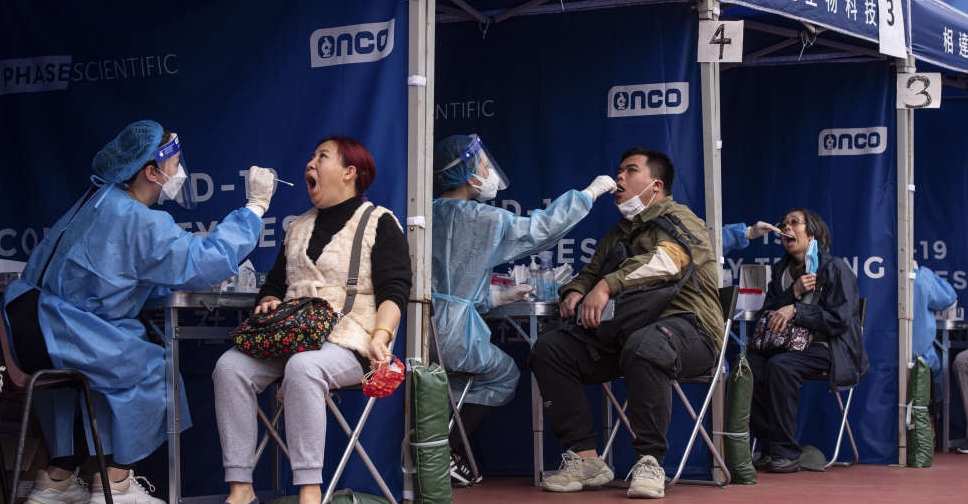
Hong Kong leader Carrie Lam on Tuesday ruled out a citywide lockdown to fight COVID-19, but a surge of infections meant she could not "preclude" the possibility of postponing next month's chief executive election.
Lam, who has not confirmed whether she will seek another five-year term as head of the Chinese ruled city, said her government's response to the outbreak had not been satisfactory with hospitals and medical staff overwhelmed.
Daily infections have surged by about 20 times over the past two weeks and Lam said authorities are unable keep pace with their testing and isolation mandate.
"There are no plans for a widespread city lockdown," she said but doubled down on her 'dynamic zero' coronavirus strategy, similar to mainland China which seeks to curb outbreaks as soon as they occur.
"We cannot surrender to the virus. This is not an option."
The city is expected to report at least 1,501 new infections on Tuesday with another 5,400 preliminary positive cases, broadcaster TVB said, citing an unidentified source.
Health authorities reported a record 2,071 infections on Monday, with another 4,500 preliminary positive cases.
Asked whether the city's chief executive election, set for March 27, would go ahead, Lam said that the plans were unchanged, but given "the severity and speed of this latest wave" the situation would be continuously reviewed.
"So, I cannot preclude any possibilities at this moment,” she said.
A committee of 1,500 members, all vetted by authorities for their "patriotism" and loyalty to Beijing, participate in electing the next leader. The chief executive election has never been postponed since the city's handover from Britain to China in 1997.
Two years ago, authorities cited the coronavirus ito postpone legislative elections, in which some seats are assigned via public vote. Those elections were held in December 2021 under new “patriots only” rules imposed by Beijing.
Restrictions on social and public gatherings, imposed after the pandemic first struck, helped Hong Kong's authorities stifle a pro-democracy movement whose mass protests had rocked the city in 2019, and a national security law imposed by Beijing in June 2020 effectively ended the unrest.


 Trump says Iran war deal close as Strait of Hormuz tensions linger
 Ukraine and Russia trade overnight drone strikes, officials say
 Trump cancels US strikes on Iran, citing progress in talks
 South Korea court sentences ex-President Yoon to 30-year jail term in drone case
 Thai king's eldest daughter dies, aged 47, after long illness
 US confirms third strike on Indian-crewed tankers this week
 UK defence minister Healey quits, says PM Starmer's plans fail to keep country safe
 False alarm at the Pentagon triggers brief shelter-in-place order