

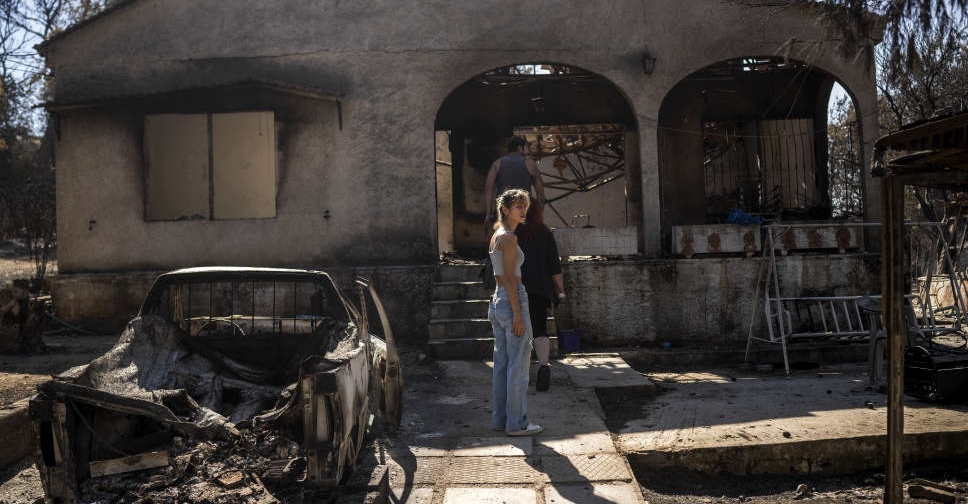
Firefighters battled on Wednesday to extinguish the remnants of a wildfire near Athens that killed a woman, torched buildings, devoured woodland and forced thousands of people to flee their homes.
Most of the fronts had eased three days after the inferno had first taken hold, but officials warned against complacency.
"The fire is still in progress. It has not been brought under control yet," a fire brigade official said.
State inspectors started assessing damaged buildings as fire-stricken residents returned to their scorched properties, hoping to find some belongings amidst the debris.
Hundreds of firefighters assisted by 12 aircraft have been tackling the blaze since Sunday as it barrelled from a forest off the town of Varnavas, 35 km from the capital, into Athens' northern suburbs.
Greece's National Observatory said the fire had damaged around 10,000 hectares of land. The cause of the blaze has not yet been determined.
Greece is on high fire alert until Thursday, with temperatures forecast to hit 40 degrees Celsius raising concern about possible flare ups.
The country, which has recently tightened penalties for arson, has dealt with over 3,500 fires since May, a nearly 50 per cent increase from the same period in 2023 when it recorded 2,300 blazes, government spokesman Pavlos Marinakis said.
Prime Minister Kyriakos Mitsotakis chaired a meeting about the latest blaze on Tuesday evening.
"We are trying to improve every year. But conditions are only becoming tougher," he told ministers according to a government official.
Sunday's fire broke rapidly across several fronts reaching within hours the seaside area of Nea Makri, the historic town of Marathon and suburbs on the slopes of Mount of Penteli, which is considered one of Athens' last green lungs.
A woman was found dead inside a burned local business in the suburb of Vrilissia, about 10 km from central Athens, on Monday.
The government has announced compensation and relief measures for those impacted by the disaster.
Some experts said the fire had managed to spread so fast because of a phenomenon called spotting, where wind whirls transfer burning matter across long distances. That led to the constant creation of new fronts which later merged.

 11 injured in Houthi attack on Riyadh financial district tower
 Explosion kills 6, injures 10 in Vietnam capital Hanoi
 Pakistani pilot to become first foreigner to fly to China's space station
 Sheikh Hasina seeks to return to Bangladesh on December 16 on state carrier
 Israeli airstrikes kill at least six Palestinians in Gaza, medics say
 Israeli airstrike kills at least 3 Palestinians in southern Gaza, medics say
 South Korea toughens school exam rules after smart-device cheating scandal
 Russian attack on Ukraine's Dymer in Kyiv region kills 11, official says