
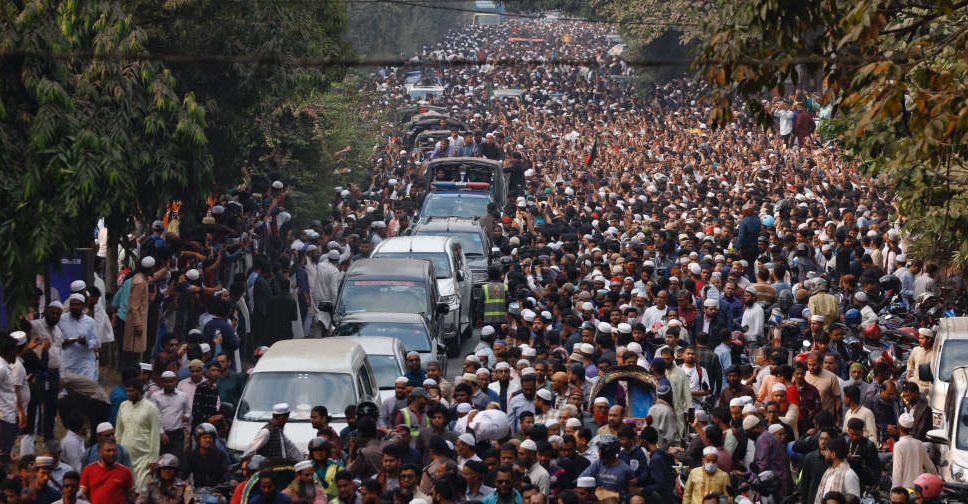
Tens of thousands of Bangladeshi mourners, including the country's interim government leader, attended the funeral on Saturday of a slain youth leader and election candidate amid tight security.
Sharif Osman Hadi, 32, a key figure in last year's student-led uprising that toppled longtime Prime Minister Sheikh Hasina, was shot in the head by masked assailants in Dhaka last week while launching his campaign for an election due in February. He died on Thursday in Singapore after six days on life support.
His death has prompted a wave of unrest in the South Asian nation that included coordinated mob attacks on major newspapers and cultural institutions.
Police and paramilitary forces were deployed across the capital for Saturday's funeral but there were no reports of any renewed violence.
Interim government leader Muhammad Yunus said Hadi's legacy would endure, describing the funeral as a collective pledge to uphold the ideals he had championed. "Today, we have come to promise you (Hadi) that we will fulfil what you stood for," Yunus, a Nobel Peace Prize laureate, told the mourners, who included Bangladesh's army chief and representatives from across the political spectrum.
In a rare and symbolic honour, Hadi was laid to rest on the Dhaka University campus beside the grave of national poet Kazi Nazrul Islam.
BANGLADESHIS HOPE ELECTION WILL END YEARS OF INSTABILITY
Bangladesh is to elect a new parliament on February 12 - a transition many hope will help the Muslim-majority nation of 175 million people recover from nearly two years of instability and reclaim its position as a regional success story.
But frequent bouts of violent protests and political wrangling among disparate groups including hardliners have punctured the national sense of euphoria that arose after Hasina was ousted in August 2024.
It has also exposed the limitations of Yunus' interim government, analysts say, raising questions over his grip on governance in the world's largest apparel producer after China.
The government has declared Saturday a day of state mourning for Hadi and has urged citizens to resist "mob violence by fringe elements", warning that turmoil threatens Bangladesh’s fragile democratic transition.
Human Rights Watch called Hadi’s killing a "terrible act" and urged the government to act urgently to halt the violence that has gripped the country since Hasina's ouster.
The rights group also condemned the attacks on media as an assault on free expression.
Bangladesh ranks 149th of 180 countries in the World Press Freedom Index. Rights groups say continued attacks on journalists and activists could further shrink civic space ahead of the election.
Amnesty International urged prompt, independent investigations into Hadi's killing and the subsequent violence, including the burning of newspaper offices and harassment of journalists.
Demonstrations continued on Friday in the Shahbagh area of the capital, where crowds demanded justice for Hadi and accountability for the attacks. A mob stormed the Dhaka office of Udichi Shilpigosthi, Bangladesh’s premier progressive cultural organisation. The violence has spread beyond the capital. In Chittagong, protesters attacked the Indian Assistant High Commission, reflecting growing anti-India sentiment since Hasina fled to New Delhi after her ouster.
Her party, the Awami League, which has been barred from the election, has threatened unrest that some fear could derail the vote.

 At least 14 killed in explosion at weapons depot in Syria
 US hits five Iranian oil tankers after attack on Navy ships
 UK gives air traffic provider a week to probe outage that halted flights
 Serbia's President Vucic dissolves parliament, calls snap elections
 With large crowds attending, Norway lays King Harald to rest
 Jordan intercepts 18 Iranian ballistic missiles
 Air traffic control issue disrupts flights at major UK airports
 At least 73 injured after Houthi rebels attack Saudi civilian and energy facilities