

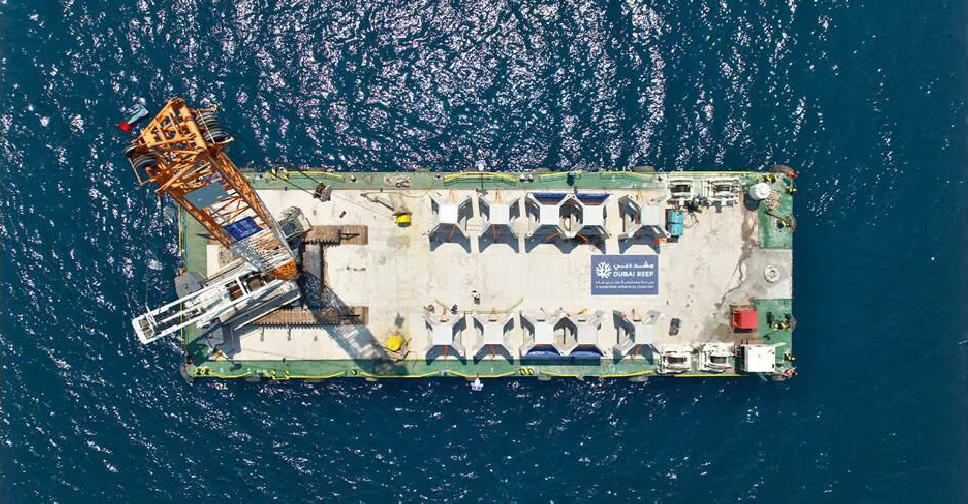
Dubai’s ambitious purpose-built reef project is showing promising signs of success in enhancing marine ecosystems within the emirate's waters.
New underwater footage from the DUBAI REEF initiative reveals a thriving marine environment around its test site, with fish populations booming and habitats forming around the reef structures.
Surveys report a rise in 15 native fish species, including snappers, groupers and barracuda — with an eight-fold increase in fish biomass and a potential 10 per cent boost in marine biodiversity.
The project, one of the world’s largest purpose-built reef developments, plans to deploy 20,000 reef modules across 600 square kilometres by 2027.
So far, nearly 40 per cent of the modules have been fabricated, and over 3,600 have already been installed.
DUBAI REEF focuses on three key pillars: habitat restoration, marine life rehabilitation, and marine conservation research — all part of a long-term strategy to protect and enhance Dubai’s marine environment.
Launched in 2024, the initiative is driven by a collaboration of strategic public and private partners including Dubai Department of Economy and Tourism (DET); Dubai Environment and Climate Change Authority (DECCA), DP World; Dubai Chambers; Nakheel, a member of Dubai Holding Real Estate; Ports, Customs and Free Zone Corporation (PCFC); and Emirates.
Together, they are advancing Dubai’s shared sustainability objectives and supporting several United Nations Sustainable Development Goals (SDGs), including SDG 13 (Climate Action), SDG 14 (Life Below Water), and SDG 17- Partnerships.

 UAE intercepts 11 ballistic missiles, 27 drones on Monday
 Sheikh Sultan establishes Sharjah Space and Astronomy Complex
 Dubai Police return over 171,000 lost items to owners in 2025
 UAE 'will emerge stronger' says H.H. Sheikh Mohammed, Cabinet approves new strategies
 UAE President and US Senator discuss regional developments
 Safety remains priority as UAE universities allowed phased return to campus
 Sheikh Abdullah condemns attacks on civilian infrastructure in region
 UAE responds to further missile, drone threats on Sunday