

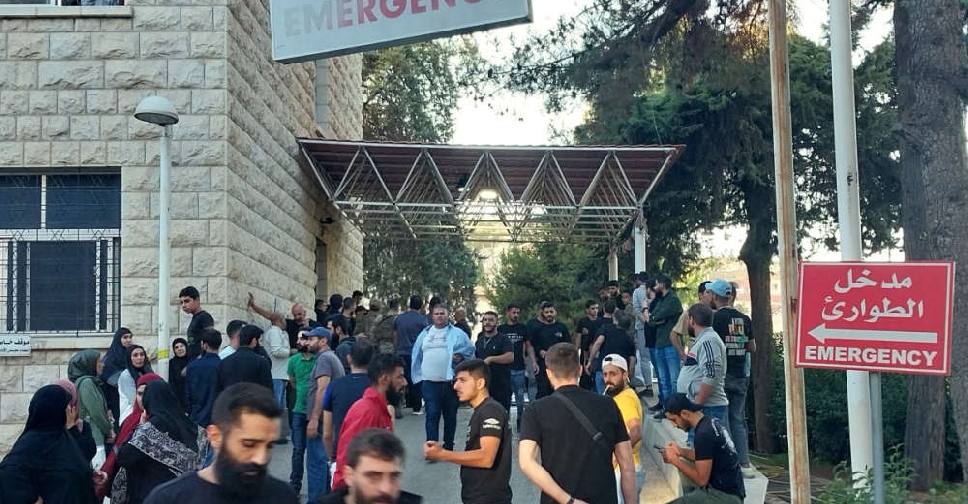
Hand-held radios used by Hezbollah detonated on Wednesday across Lebanon's south and in Beirut's southern suburbs, further stoking tensions with Israel a day after similar explosions launched via the group's pagers.
Three people were killed in Lebanon's Bekaa region, the state news agency reported, and dozens of people were wounded in the latest device blast.
At least one of the blasts took place near a funeral organised by Hezbollah for those killed the previous day when thousands of pagers used by the group exploded across the country and wounded many of the group's fighters.
The group, which was thrown briefly into disarray by the pager attacks, said on Wednesday it had attacked Israeli artillery positions with rockets.
The hand-held radios were purchased by Hezbollah five months ago, around the same time that the pagers were bought, said a security source.
The death toll from Tuesday's blasts rose to 12, including two children, Lebanese Health Minister Firass Abiad said on Wednesday. Tuesday's attack wounded nearly 3,000 people, including many of Hezbollah's fighters and Iran's envoy to Beirut.
The UN High Commissioner for Human Rights Volker Turk called for an independent investigation into the events surrounding exploding pagers.
A Taiwanese pager maker denied that it had produced the pager devices which exploded in an audacious attack that raised the prospect of a full-scale war between Hezbollah and Israel.
Gold Apollo said the devices were made under licence by a company called BAC, based in Hungary's capital Budapest.
There was no immediate word on when Hezbollah had launched its latest rocket attack but normally the group announces such strikes shortly after carrying them out, suggesting it fired at the Israeli artillery positions on Wednesday.
Hezbollah has vowed to retaliate against Israel, whose military declined to comment on the blasts. The two sides have been engaged in cross-border warfare since the Gaza conflict erupted last October, fuelling fears of a wider Middle East conflict that could drag in the United States and Iran.
Jordan's Foreign Minister Ayman Safadi accused Israel of pushing the Middle East to the brink of a regional war by orchestrating a dangerous escalation on many fronts.
"Hezbollah wants to avoid an all-out war. It still wants to avoid one. But given the scale, the impact on families, on civilians, there will be pressure for a stronger response," said Mohanad Hage Ali of the Carnegie Middle East Centre.

 Trump backs down on strikes on Iran's power network
 ICE agents begin deploying at some US airports
 Air Canada jet collision shuts LaGuardia; pilots killed, dozens injured
 Kuwait launches probe into espionage, state security cases
 Trump, Iran threaten to escalate conflict with attacks on energy and water facilities
 Fuel reservoir in Russia's Primorsk port on fire after drone attack, governor says
 Ambulances from Jewish community organisation torched, UK police say
 Israeli airstrikes kill four in Gaza, Palestinian officials say