

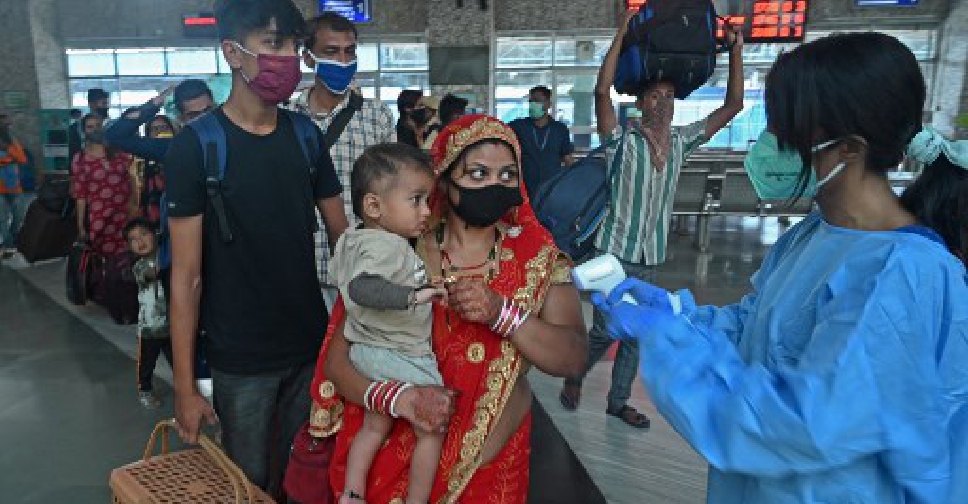
India exceeded 10 million infections of the new coronavirus on Saturday, much later than predicted as the pace of infections slows, despite many in the country giving up on masks and social distancing.
After hitting a peak of nearly 98,000 daily cases in mid-September, daily infections have averaged around 30,000 this month, helping India widen its gap with the United States, the world's worst affected country with more than 16 million cases.
India reported 25,152 new infections and 347 deaths in the past 24 hours, data from the health ministry showed. The virus has so far killed 145,136 people in the country. India took 30 days to add the last million cases, the second slowest since the start of the pandemic.
The country expects to roll out vaccines soon and is considering emergency-use request for three types, developed by Oxford/AstraZeneca, Pfizer and local company Bharat Biotech.
But some health experts say the fall in cases suggests many Indians may have already developed virus antibodies through natural infection.
"Herd immunity is a huge part of it ... which is helping us to break the transmission," said Pradeep Awate, a senior health official in India's worst-hit state of Maharashtra, home to Mumbai.
India's richest state was in dire straits back in September when its daily cases averaged 20,000 and hospitals ran out of beds and oxygen. It is now reporting fewer than 5,000 cases.
The national capital territory of Delhi said on Saturday its third and the worst surge in cases has now ended. It reported 1,418 new infections and 37 deaths on Friday.
"If infections were surging, we would have seen the number of patients in hospitals go up, especially after the festival season. That has not happened," said Raman Gangakhedkar, who until recently headed epidemiology at the Indian Council Of Medical Research.
A government-appointed panel tasked with making projections based on a mathematical model has estimated that 60% of India's 1.35 billion people have already been infected with the virus.
"If the model is correct, it is unlikely that a second wave will happen, because once 60% have immunity, nothing can cause another wave," said Manindra Agrawal, a committee member and professor at the Indian Institute of Technology in the northern city of Kanpur.
"However, the predictions of the model need to be independently confirmed by a survey for us to be certain."


 Nepal to rebuild early-warning system on China border after deadly flood, sources say
 US House passes bill to crack down on university boycotts of Israel
 Kuwait air defences deal with Iranian missile, drone attacks
 Spain's PM Sanchez says no evidence Morocco orchestrated Ceuta border surge
 Two Palestinian teens killed in West Bank raid by Israeli settlers, army
 Latest Indonesian free meal poisoning outbreaks affect 800, lawmaker says
 Chinese students marooned in floods unleashed by Typhoon Saudel's rains
 US and Iran exchange attacks as lull in war appears over