

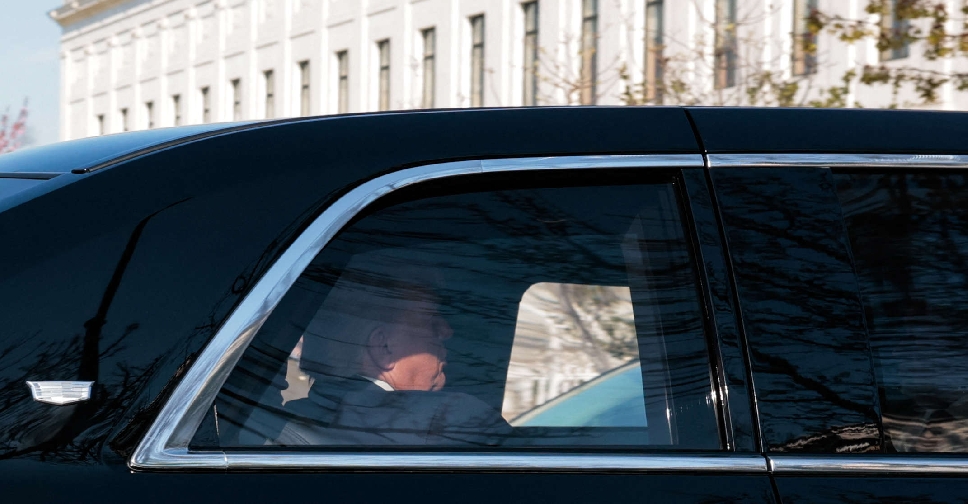
US President Donald Trump made a historic visit to the Supreme Court on Wednesday to attend arguments over the legality of a policy he considers crucial to his hardline approach toward immigration - a directive he signed last year on his first day back in office that would limit birthright citizenship.
The Republican president sat in the first row of the public section of seating in the ornate courtroom but departed not long after the lawyer arguing for his administration completed his presentation and the attorney for the challengers began hers.
Trump left quietly, accompanied by Secret Service personnel.
He was driven by motorcade from the White House and arrived before the arguments, wearing a red tie and dark suit.
Trump and other attendees rose to their feet as the court marshal made the customary announcement beginning with "Oyez! Oyez! Oyez!" - meaning "Hear ye!" - to mark the beginning of the court session.
Trump was at the courthouse for a bit more than an hour and a half, seated right next to White House Counsel David Warrington and in the same row as Commerce Secretary Howard Lutnick and Attorney General Pamela Bondi.
He became the first sitting president to attend an oral argument at the Supreme Court, according to Clare Cushman, the resident historian at the Supreme Court Historical Society.
During the arguments, which lasted more than two hours, members of the court signalled skepticism towards Trump's directive. The court is expected to rule by the end of June.
"We are the only Country in the World STUPID enough to allow 'Birthright' Citizenship," Trump wrote in a post on his Truth Social platform after arriving back at the White House.
The United States is among 33 countries with automatic birthright citizenship policies, according to the Pew Research Center.
Critics call Trump's directive a plainly unconstitutional action rooted in racially discriminatory anti-immigrant views.
Trump's motorcade drove from the White House along Constitution Avenue and then Independence Avenue, passing the Washington Monument and the National Mall, with crowds watching from the sidewalk.
There are examples of 19th century presidents arguing cases before the court - though not while in office - including John Quincy Adams, Grover Cleveland and Benjamin Harrison.
William Howard Taft, who served as president from 1909 to 1913, later became the chief justice on the Supreme Court.
DEMONSTRATORS AT THE COURTHOUSE
Outside the neoclassical courthouse on Capitol Hill, demonstrators gathered ahead of the arguments, some holding anti-Trump signs including ones reading "Trump must go now."
Chief Justice John Roberts did not acknowledge Trump's presence before announcing the beginning of arguments in the case known as Trump v. Barbara.
There appeared to be more security personnel than usual in the courtroom.
The Supreme Court has backed Trump in a series of rulings issued on an emergency basis since he returned to the presidency last year.
Those decisions came on matters including immigration, mass federal layoffs, cutting foreign aid, dismantling the Education Department, banning transgender people from the military and other areas.
But the court on February 20 ruled against Trump in a major case testing the legality of the sweeping global tariffs he imposed last year under a law meant for use in national emergencies.
Since the tariffs ruling, Trump has lashed out repeatedly at the Supreme Court and the six justices who ruled against him in that case.
The Supreme Court's 6-3 conservative majority includes three justices appointed by Trump during his first term in office - Neil Gorsuch in 2017, Brett Kavanaugh in 2018 and Amy Coney Barrett in 2020.
Trump and senior officials in his administration often have denounced judges who have ruled against his policies, sometimes in highly personal terms.
Three of the court's six conservative justices - Chief Justice John Roberts as well as Gorsuch and Barrett - joined with its three liberal members in ruling that Trump had overstepped his authority in imposing tariffs.
Trump was incensed at Gorsuch and Barrett in particular, calling them on the day of that ruling "an embarrassment to their families."
And last week, Trump kept up his condemnation of his two appointees, saying that "they sicken me because they're bad for our country."
Trump after the tariffs ruling said he was "ashamed" of the three conservative justices who ruled against him, calling them "fools and lapdogs for the RINOs and the radical-left Democrats." RINO, meaning "Republican in name only," is a term sometimes used by conservative Republicans to insult fellow Republicans viewed as disloyal to the party.
A lower court blocked Trump's executive order directing US agencies not to recognize the citizenship of children born in the United States if neither parent is an American citizen or legal permanent resident, also called a "green card" holder.
Trump wrote on social media last year: "Birthright Citizenship was not meant for people taking vacations to become permanent Citizens of the United States of America, and bringing their families with them, all the time laughing at the 'SUCKERS' that we are!"

 Trump says Iran has asked for a ceasefire, US wants to see Hormuz open first
 15 deaths confirmed after measles outbreak in Bangladesh
 Iranian missile strikes oil tanker in Qatar
 Australia's Albanese says war's economic shock will be felt for months
 Iranian drones target fuel tanks at Kuwait International Airport
 At least 18 dead after migrant boat sinks off Turkey's Aegean coast
 Rubio says US can see 'finish line' on Iran war
 Fire breaks out at company facility in Bahrain after Iranian attack