

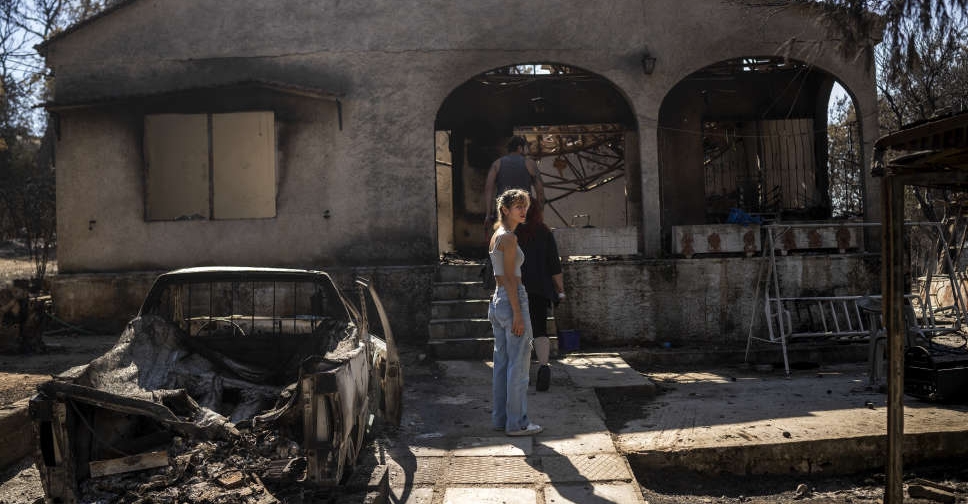
Firefighters battled on Wednesday to extinguish the remnants of a wildfire near Athens that killed a woman, torched buildings, devoured woodland and forced thousands of people to flee their homes.
Most of the fronts had eased three days after the inferno had first taken hold, but officials warned against complacency.
"The fire is still in progress. It has not been brought under control yet," a fire brigade official said.
State inspectors started assessing damaged buildings as fire-stricken residents returned to their scorched properties, hoping to find some belongings amidst the debris.
Hundreds of firefighters assisted by 12 aircraft have been tackling the blaze since Sunday as it barrelled from a forest off the town of Varnavas, 35 km from the capital, into Athens' northern suburbs.
Greece's National Observatory said the fire had damaged around 10,000 hectares of land. The cause of the blaze has not yet been determined.
Greece is on high fire alert until Thursday, with temperatures forecast to hit 40 degrees Celsius raising concern about possible flare ups.
The country, which has recently tightened penalties for arson, has dealt with over 3,500 fires since May, a nearly 50 per cent increase from the same period in 2023 when it recorded 2,300 blazes, government spokesman Pavlos Marinakis said.
Prime Minister Kyriakos Mitsotakis chaired a meeting about the latest blaze on Tuesday evening.
"We are trying to improve every year. But conditions are only becoming tougher," he told ministers according to a government official.
Sunday's fire broke rapidly across several fronts reaching within hours the seaside area of Nea Makri, the historic town of Marathon and suburbs on the slopes of Mount of Penteli, which is considered one of Athens' last green lungs.
A woman was found dead inside a burned local business in the suburb of Vrilissia, about 10 km from central Athens, on Monday.
The government has announced compensation and relief measures for those impacted by the disaster.
Some experts said the fire had managed to spread so fast because of a phenomenon called spotting, where wind whirls transfer burning matter across long distances. That led to the constant creation of new fronts which later merged.

 Kuwait International Airport suffers 'significant damage' after drone attacks
 Israeli strike kills three Lebanese journalists, reports say
 Israeli military kills 15-year-old Palestinian in West Bank
 Russian drones kill four in Ukraine, damage key infrastructure
 Manila, Beijing resume talks on South China Sea, energy security
 Yemen's Houthis confirm launching attack on Israel
 Nepal's former PM arrested over Gen Z protests deaths
 UN establishes task force to address Hormuz navigation challenges