

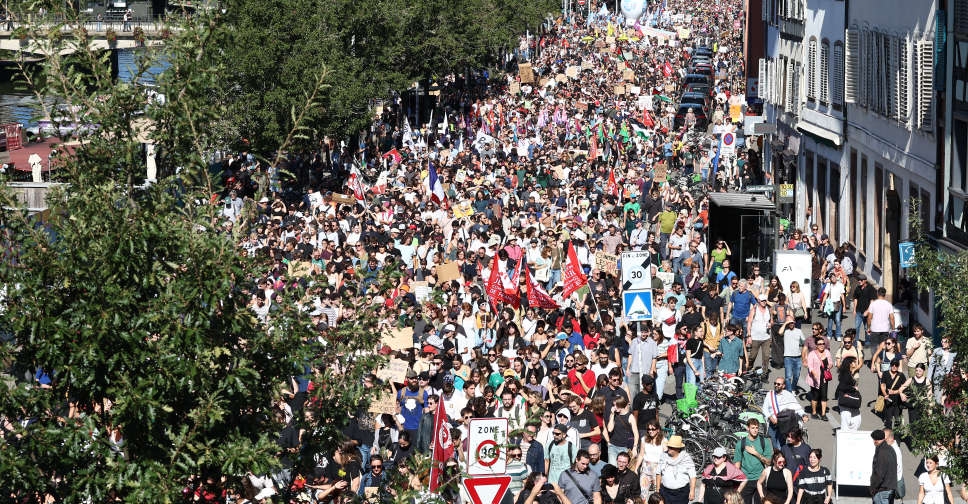
Hundreds of thousands took part in anti-austerity protests across France on Thursday, urging President Emmanuel Macron and his new Prime Minister Sebastien Lecornu to acknowledge their anger and scrap looming budget cuts.
Teachers, train drivers, pharmacists and hospital staff were among those who went on strike as part of the day of protests, while teenagers blocked dozens of high schools for hours.
Protesters and unions called for the previous government's fiscal plans to be scrapped, for more spending on public services, higher taxes on the wealthy and for the reversal of an unpopular change making people work longer to get a pension.
"The anger is immense, and so is the determination. My message to Mr. Lecornu today is this: it's the streets that must decide the budget," said Sophie Binet, head of the CGT union.
The CGT said 1 million people took part in the strikes and protests. Authorities estimated the number of protesters at about half that number.
There were some clashes on the margins of the rallies but the level of violence was not as high as Interior minister Bruno Retailleau had feared.
"I would like to emphasise that in almost all cases, marches and demonstrations took place under favourable conditions," he said during a briefing held shortly after the end of the Paris rally.
UNIONS WANT TO PRESSURE GOVERNMENT ON BUDGET
Macron's new prime minister is scrambling to put together a budget for next year, as well as a new government.
On a post on X, he vowed to meet the unions again "in the coming days, adding, "The demands made by the union representatives and echoed by demonstrators in the marches are at the heart of the consultations I have initiated."
Lecornu and Macron are under pressure on one side from protesters and left-wing parties opposed to budget cuts and, on the other, from investors concerned about the deficit in the euro zone's second-largest economy. Parliament is deeply divided and none of its three main groups has a majority.
"This is a warning, a clear warning to Sebastien Lecornu," said Marylise Leon, the head of the CFDT, France's largest union. "We want a socially fair budget."
PROTESTS HIT SCHOOLS, TRAINS
One in three primary school teachers was on strike nationwide on Thursday, and nearly one in two walked off the job in Paris, the FSU-SNUipp union said.
Regional trains were heavily affected, while most of the country's high-speed TGV train lines worked, officials said. Protesters gathered to slow down traffic on a highway near the southeastern city of Toulon.
In Paris, police on several occasions threw teargas to disperse troublemakers dressed in black who hurled beer cans and stones at them. Police also stepped in to stop people targeting banks.
There were brief clashes on the margins of some of the other protests as well, including in Nantes, and in Lyon, where French media said three people were injured.
More than 180 people have been arrested, the interior ministry said. Some 80,000 police and gendarmes were set to be deployed throughout the day, including riot units, drones and armoured vehicles.

 Iran accuses US of ground assault plans as Pakistan hosts regional talks
 Fugitive accused of killing two Australian police officers shot dead
 Netanyahu orders expansion of security buffer zone in southern Lebanon
 Ten Kuwaiti troops injured in Iranian missile attack
 Oman says no party has claimed responsibility for attacks on its territory
 Anti-Trump 'No Kings' rallies pop up in thousands of US cities
 Six killed after Israeli strikes hit two Gaza police checkpoints, medics say
 Bahrain's aluminum producer confirms Iranian attack on facilities