

The UAE ranked first among Arab countries in the Global Knowledge Index (GKI) 2026, and 26th globally, scoring 60.4 points, reaffirming its role in building an innovation-and technology-driven economy and developing human capital.
The Mohammed bin Rashid Al Maktoum Knowledge Foundation (MBRF) and the United Nations Development Programme (UNDP) announced the GKI results during the special edition of Knowledge Summit 2026, held in Dubai under the theme “Knowledge: Navigating Crises in a Changing World”.
The summit brought together decision-makers, experts, researchers and specialists in knowledge, development and innovation.
Saudi Arabia ranked second among Arab countries and 47th globally with 50.4 points, followed by Qatar in third place regionally and 59th globally (48.1 points), Bahrain in fourth place regionally and 67th globally (46.3 points), and Oman in fifth place regionally and 72nd globally (45.5 points).
Switzerland topped the overall index with 69.8 points, followed by Singapore (69.0 points), Sweden (68.4 points), Denmark (66.0 points) and Norway (65.9 points).
The index provides a comprehensive understanding of how countries generate, disseminate, and apply knowledge to advance sustainable human development.
Jamal bin Huwaireb, CEO of MBRF, said GKI 2026 highlights the importance of knowledge as a fundamental pillar in strengthening countries’ ability to address challenges and adapt to rapid global transformations.
He noted that the UAE’s regional leadership reflects its leadership’s vision of prioritising investment in people, education and innovation as essential foundations for sustainable development.
Dr. Hany Torky, Chief Technical Adviser and Project Manager of the Knowledge Project at UNDP, said the GKI 2026 report highlights the pivotal role of knowledge in strengthening countries’ ability to prepare for, address and recover from crises.
He explained that the index provides a comprehensive assessment of countries’ knowledge capabilities across six dimensions: pre-university education; technical and vocational education and training (TVET) and higher education; research, development and innovation (RDI); information and communications technology (ICT); the economy; and environmental, social and governance (ESG).
The report underscores the importance of investing in knowledge, skills and innovation to transform challenges into opportunities for building more resilient and sustainable economies and societies.
The results also highlight disparities in knowledge performance among countries, reinforcing the need for continued investment in education, scientific research, innovation and digital transformation to address global economic, social and environmental challenges and achieve sustainable development.

 Death toll rises to 13 in Ras Al Khaimah bus-truck collision
 flydubai says 'working with relevant authorities' to resume Tel Aviv operations
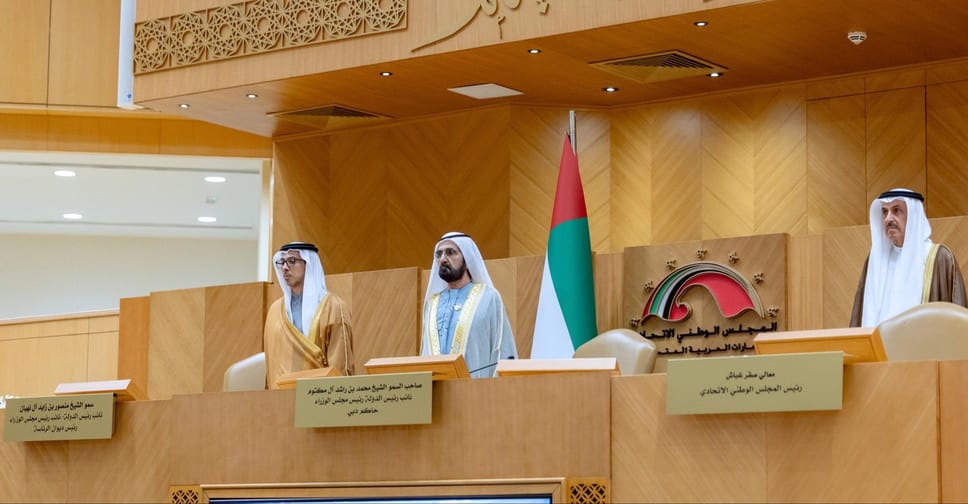 H.H. Sheikh Mohammed opens new FNC session
 UAE pledges $30,000 to developing countries
 Sheikh Abdullah meets global counterparts
 UN water conferences to be held every 3 years under UAE-Senegal resolution
 UAE President discusses national priorities with Fujairah Ruler
 H.H. Sheikh Mohammed to open new FNC session