

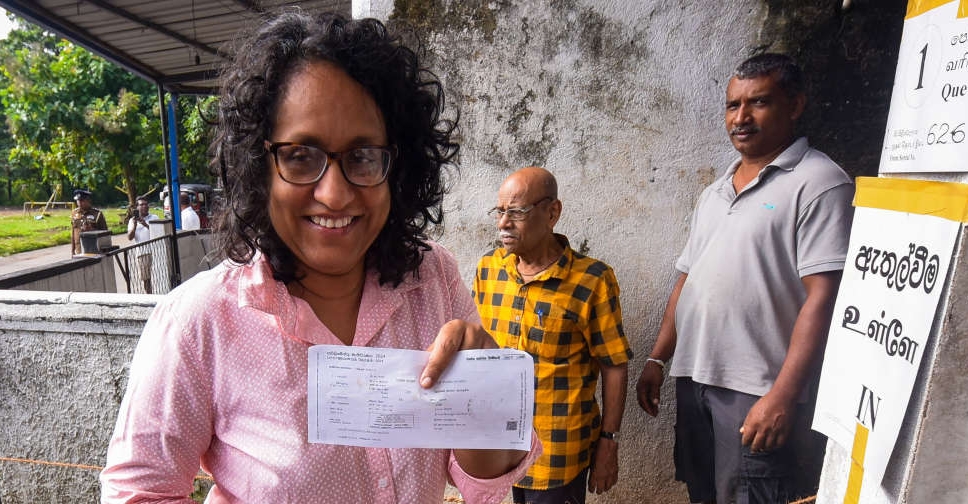
Sri Lankan President Anura Kumara Dissanayake retained the key finance minister portfolio and reappointed Harini Amarasuriya as prime minister on Monday as the Indian Ocean island nation targets stronger recovery from a draining financial crisis.
Dissanayake, whose leftist coalition won a record 159 seats in the 225-member parliament in a general election last week, also reappointed veteran legislator Vijitha Herath to helm the foreign affairs ministry.
Dissanayake, who has held the key finance minister portfolio since he was elected in September, will continue in that role, two party sources told Reuters, as Sri Lanka looks to chart a stronger recovery out of its worst financial crisis since independence from the British in 1948.
A delegation from the International Monetary Fund (IMF) is in Colombo for a third review of its $2.9 billion programme that is expected to release a tranche of about $337 million.
The new parliament will meet on Thursday to elect a speaker and Dissanayake will present his key policy priorities to the newly minted lawmakers.
"This power comes with accountability. Accountability to the people, and this power should be wielded with humility, restraint and boundaries. I have every confidence in this cabinet and parliament," Dissanayake said in a speech after the swearing-in.
"The real work we will be judged on begins now."
A nation of 22 million, Sri Lanka was crushed by a 2022 economic crisis triggered by a severe shortage of foreign currency that pushed it into a sovereign default and caused its economy to shrink by 7.3 per cent in 2022 and 2.3 per cent last year.
The president will have to present an interim budget in the next few weeks, as well as find ways to reduce taxes and increase welfare, which were his key election pledges, without derailing the IMF programme.
Dissanayake will also have to complete a $12.5 billion debt restructuring with bondholders and put growth on a sustainable path.
A political outsider in a country dominated by family parties for decades, Dissanayake comfortably won the island's presidential election in September.
But his Marxist-leaning National People's Power (NPP) coalition had just three seats in parliament, prompting him to dissolve it and seek a fresh mandate in last Thursday's snap election.
Prime Minister Amarasuriya, 54, polled the second highest number of preferential votes, and is an academic with a doctorate in social anthropology from the University of Edinburgh. She will also hold the education and higher education portfolios.

 2 people rescued alive from Nepal hydropower tunnel
 US investigates deadly strike on Iranian wedding
 Nepal flood losses estimated at $2.56 billion, official says
 Kuwait air defences deal with Iranian missile, drone attacks
 Nepal to rebuild early-warning system on China border after deadly flood, sources say
 US House passes bill to crack down on university boycotts of Israel
 Spain's PM Sanchez says no evidence Morocco orchestrated Ceuta border surge
 Two Palestinian teens killed in West Bank raid by Israeli settlers, army