

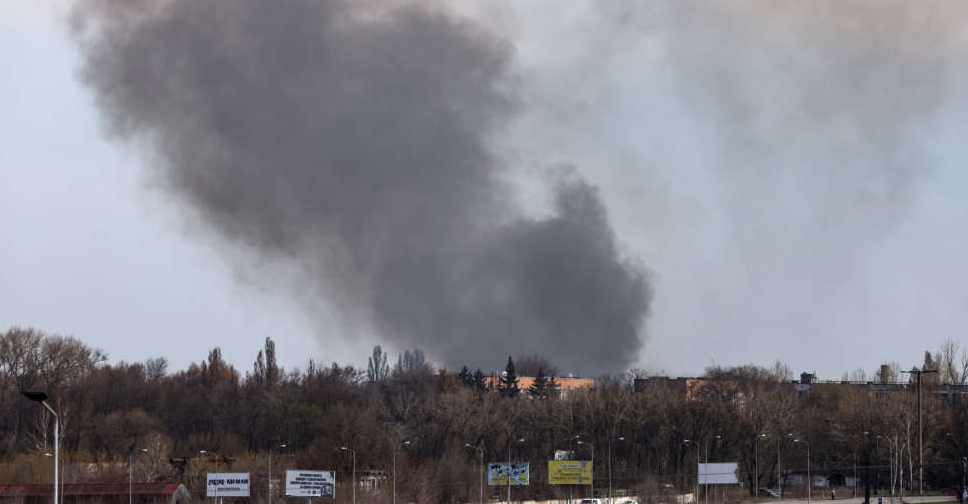
Russian forces fired rockets into Ukraine's Luhansk and Dnipro regions on Sunday, Ukrainian officials said, completely destroying an airport and potentially leaving casualties.
Valentyn Reznichenko, governor of the central Dnipropetrovsk region, said emergency workers were combing through an infrastructure facility that was hit in the town of Zvonetsky, adding that details on casualties would be given later.
"Overnight high-precision missiles destroyed the base and headquarters of the nationalist Dnepr battalion in Zvonetsky, which also recently received reinforcements from foreign mercenaries," Russia's Defence Ministry said.
Reznichenko said on Telegram that there had also been an attack on the airport in Dnipro city.
"The airport itself was destroyed, as well as nearby infrastructure. And the rockets fly and fly," Reznichenko said.
Reznichenko said earlier that an attack on Dnipro had wounded one person and the rockets had sparked a fire that was eventually put out. A missile had also hit a building in the Pavlograd district, he added.
Separately, the head of the Dnipro region council, Mykola Lukashuk, says five staffers of the state emergency service had been wounded by the strike on the airport.
Serhiy Gaidai, governor of Luhansk, an eastern region bordering Russia, wrote earlier on Telegram that a school and a high-rise apartment building had been hit in the city of Sievierodonetsk.
"Fortunately, no casualties," Gaidai said.
Reuters could not immediately confirm the reports.


 Putin says US-Russia contacts beneficial as talks begin with Witkoff and Kushner
 Chinese national rescued from Nepal tunnel 10 days after flash flood
 US envoys Witkoff, Kushner arrive in Moscow for talks on peace in Ukraine
 One dead, 11 people missing after mudslide in China's Jiangxi province
 Philippine VP Duterte posts bail after arrest order for alleged grave threats
 Lindsay Clancy trial over killing her children ends in mistrial
 Israel says it strikes southern Lebanon after Hezbollah drone launch
 Sydney sweats in spring hot spell, faces 'extreme' bushfire risk