
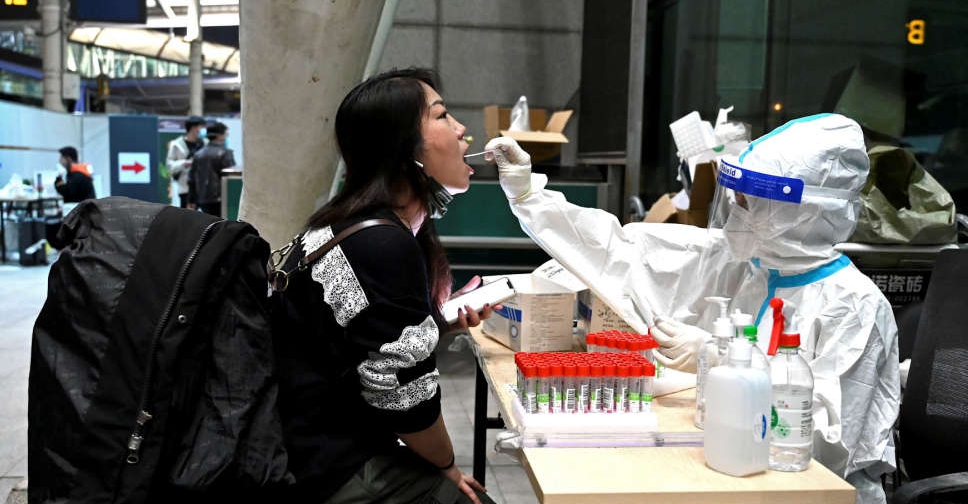
In footage shared on social media last week, a crowd of people in the northeastern Chinese city of Shenyang bang against the windows of a clothing market as they shout in frustration at the announcement of yet another round of COVID-19 tests.
The comments reflect the growing frustrations throughout China as authorities use all the tactics in their "zero-COVID" playbook to grapple with the more infectious Omicron variant.
As case numbers surge, members of the public are wondering whether the government's increasingly complex "dynamic clearance" methods - including the continuous testing of residents - still work.
At a briefing last week, Wang Hesheng, vice-head of the country's National Health Commission, said China's increasingly refined tactics had reduced inconvenience.
"It shows that at the cost of the normal activities of very small numbers of people, and the control of movement in very small areas, what comes in exchange is normal production and normal life for the widest range of regions and people," he said.
But there have been signs that a lack of clarity and consistency is exasperating the public, and China's social media censors have been working overtime to try to clear the tide of complaints.
In Yanjiao in Hebei province, a dormitory town for workers in Beijing, residents have been struggling to get home amid stringent lockdowns.
Images shared online, many of which have already been deleted, showed residents queuing in heavy snow for test results to get out of the capital. The posts drew hundreds of comments.
"It's been three years since the outbreak and the government is still so ineffective in handling it - lazy one-size-fits-all government in complete disregard for the life and death of the people," said one netizen, posting on China's Twitter-like Weibo platform under the username Aobei.
Economic hardships have also been mounting. A courier surnamed Mao in the badly hit city of Changchun in northeastern Jilin province told Reuters that 90 per cent of the neighbourhoods have been shut down, and he couldn't earn a living.
"I don't have any choice, I can only wait for them to unseal the city - it's hopeless," he said.
ARBITRARY CONTROLS
Residents have also complained about the arbitrary nature of the rules as well as the unchecked power of the neighbourhood residential committees responsible for enforcing them.
In Beijing, one family said their residential committee was about to install a monitoring device on their apartment door to ensure they complied with an order to stay home for two weeks. The order came after a family member entered a supermarket that had been visited two days before by a confirmed COVID-19 case.
In Shanghai, residents were also bewildered by the uneven testing standards and lockdown thresholds imposed by apartment blocks and compounds across the city.
But China's policies have caused more than mere inconvenience, with netizens increasingly willing to discuss how lockdowns led to tragedy.


 One dead, 11 people missing after mudslide in China's Jiangxi province
 Philippine VP Duterte posts bail after arrest order for alleged grave threats
 Lindsay Clancy trial over killing her children ends in mistrial
 Nine days after disaster, two pulled alive from Nepal hydropower tunnel
 Germany launches manhunt after spate of sabotage attacks on power grid
 Air India sack Phuket-Delhi pilot who failed drug test
 Wildfires spread near Indonesia's new capital, prompting calls for action
 Philippine court issues warrant for VP Duterte's arrest in grave threats case